
MOOWR unit offers deferred duty payment of customs duties without imposing export obligations. It also allows trading.
MOOWR scheme grants upfront benefit of deferment of payment of customs duty on the imported goods meant for use in the permitted operations / manufacture till the period the imported / resultant goods are removed from the MOOWR unit. Unlike many other schemes, the MOOWR scheme does not impose any additional requirement of earning foreign exchange. In fact, there is freedom from obligatory export, which are inseparable necessities of EOU, EPCG, Drawback or SEZ scheme.
 This scheme encourages and enables businesses to manufacture goods indigenously by effectively saving the import duty on the value addition and lowering dependency on imported items.
MOOWR scheme makes it economically viable for nations promoting industrial growth to generate opportunities for import substitutes and the tertiary industry, wherein duty rates and value addition are higher than at the primary levels in a given value chain.
RESULTANT GOODS SUPPLIED TO TAXABLE: If the resultant goods from a MOOWR unit is cleared into the DTA, the customs duty is limited to the customs duty applicable to the content of the warehoused inputs in the resultant goods. Thus, the value addition (on account of the costs of domestic goods, labor, overheads, profit, etc.) does not suffer the duty of customs when resultant goods are sold in DTA, unlike a clearance from an SEZ unit.
EXPORT OF RESULTANT GOODS: If the warehoused goods or the resultant goods are exported, then the unpaid customs duty gets absolved, and the bond is released to that extent. There is no relative compulsion to export or to sell in India. Even if an importer of Capital goods or inputs has no export orders and has no inclination to export anything, a MOOWR unit is possible.
Goods manufactured in a MOOWR unit shall carry the manufactured in India tag. When exported abroad, these goods shall be treated at par with goods manufactured in India and thus will boost the Aatma-nirbhar Bharat vision of Indian people and government.
PHYSICAL CONTROL: The department has removed physical control on all supplies/goods, except the following:
- Precious metals (silver, gold, platinum, iridium, osmium, palladium, rhodium, & ruthenium)* and articles thereof.
- Imported goods meant for supply to duty-free shops in a customs area.
- Imported goods meant for supply as stores to vessels or aircrafts**.
- Supply to foreign privileged persons***.
MOOWR is a stand-alone scheme operating within the four corners of the Customs law. Customs law and procedure is adapted by the provision of an In-bond Bill of entry, also called ‘BoE for warehousing’ The compliance and control mechanism is online and divided between the two Commissionerates having jurisdiction over the factory and the Customs port of import.
These features create immense potential for certain types of businesses. Compared with other schemes and programs under FTP, the MOOWR scheme has the potential to be the most preferred scheme for some specific combination of imported and exported goods. Overall, MOOWR unit offers a cost-saving opportunity to an import intensive business model.
EXAMPLES: MOOWR unit remarkably supports an industry model where ITC of IGST paid on imported capital goods is not available due to some reason. For e.g., in India alcoholic liquor falls under exclusive state jurisdiction for levy of taxes. This is constitutionally tangent to the provision for GST whereby the central and all state governments must concur for levy of GST. The feature of ‘value added tax’ built into the GST laws is not exploitable by the alcoholic liquor industry. In short, ITC of IGST paid on imported capital goods is not available to such manufacturers. If such manufacturer opts for a MOOWR unit, then such entire IGST (along with Customs as well) is deferred till the time such capital goods is cleared from the unit. At the end-of-life cycle of the bonded capital goods the investors can opt to export or destroy such without payment and seek liberation from the bond. Here again there is no compulsion and the importer is free to pay the duty or export at own decision and time.
As against the above a MOOWR unit will not be feasible if the rate of AIR – All industries rate – of Drawback on export of the resultant goods from a non-MOOWR unit count far higher than the deferred/saved duties by opting a MOOWR unit.
TRADING OF WAREHOUSED GOODS: Another advantage the MOOWR scheme holds over EOU/SEZ scheme is the flexibility to trade in imported goods, including export without payment of customs duty. No additional permission/license is required for this.
Imported goods can be warehoused for a period of up to one year for trading purpose. This period can be extended upon sufficient cause. The owner is free to export the goods and redeem the bond without payment of any import duties. In case the warehoused goods are cleared for home consumption, import duty is required to be paid at the prevailing rates. An interest-free period of 90 days from the date of in-bonding is available for all warehoused goods finally cleared for home consumption.
*As per Note 4 to Chapter 71 of the First Schedule to the Customs Tariff Act, 1975.
**These supplies are further covered by the provisions under Chapter XI of the Customs Act, 1962.
***Foreign privileged persons are defined under the Foreign Privileged Persons (Regulation of Customs Privileges) Rules, 1957.
Disclaimer:
The content of this update is solely for informational purpose. It does not constitute professional advice or recommendation of firm. Neither the author nor firm and its affiliates accepts any liabilities for any loss or damage of any kind arising out of any information in this update nor for any actions taken in reliance thereon.
For personalized advisory, email office@optitaxs.com
Recommended material for more insights in MOOWR
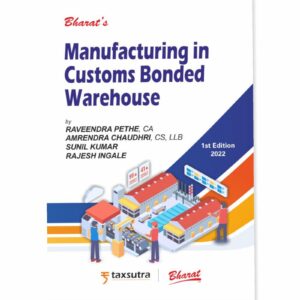
Senior Advisors in Team Optitax authored the only book in relation to MOOWR unit [Bharat Law ISBN 9789394163188]
Name of the book: Manufacturing in Customs Bonded Warehouse
Authors: Raveendra Pethe, Amrendra Chaudhri, Sunil Kumar, Rajesh Ingale
Paperback publishers: Bharat Law House Pvt Ltd
Online publisher: Taxsutra [https:lnkd.in/gsqVECCa]
Highlights:
- First of its kind book to consolidate & discuss legal provisions of MOOWR
- Covers legal provisions related to warehousing
- Interpretation of provisions related to compliance and record management
- Analysis of specific provisions for certain commodities
- Provides references supporting the discussions
- End to end description of application process with broad level guidelines
- Covers the CBIC/ Commissionerate procedures
- The discussion covers the procedures and instructions circulated by the Board and the Commissionerates
- Wherever possible comparisons of various options and provided in charts
- Provides expounded legal provisions specific to various commodities
- In depth study on business opportunities in bonded warehouse and MOOWR
- Contains FAQs from own study
- A comprehensive subject index at the end
 |